


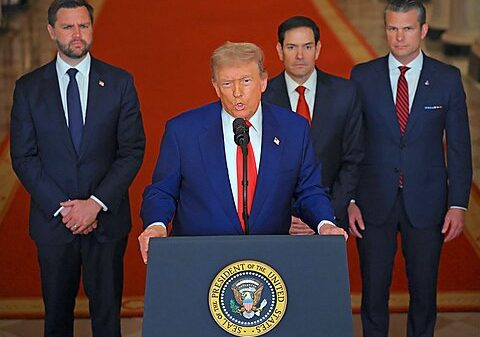

Another day, another boomer war, another boomer remark from America’s head of state. This morning, President Donald Trump posted on Truth Social that, “There will be no deal with Iran except UNCONDITIONAL SURRENDER!”
The president here applies a World War II analogy to a current geopolitical issue. Words like “appeasement,” “axis,” and “unconditional surrender” fill the airwaves and take up news columns regarding Iran. Some even compare the Iranian regime to Nazi Germany, suggesting that the United States has the duty, the obligation, to stop this bloodthirsty and tyrannical regime before it conquers the region.
Yet policymakers and commentators who use such analogies fail to define ends and means of this war with Iran, instead relying on nostalgic feelings of American greatness from World War II to guide today’s military policy.
The military historian Michael Howard criticized the use of analogies in military history, seeing them as overly simplistic and inapplicable to describe a specific war’s causes and cessation. While there are some general commonalities in warfare and geopolitics throughout time, each period has different actors, different capabilities, and different relative power dynamics between countries. Analogies blind us to the realities of a conflict.
Many generals and European leaders at the dawn of World War I, for instance, held fast to the Napoleonic way of war, viewing sheer willpower and rapid offensives as the keys to victory. Ultimately, these leaders blinded themselves to the reality of increased firepower, forcing soldiers to dig trenches and suffer massive casualties in a war of attrition. And in 1965, Lyndon Johnson defended his administration’s escalation in Vietnam, likening North Vietnam to Nazi Germany with the claim that “we learned from Hitler and Munich that success only feeds the appetite of aggression.” When South Vietnam fell ten years later, no dominoes fell in Southeast Asia, and Ho Chi Minh did not invade other countries as Hitler did in 1938. Tragically, it took the deaths of roughly 58,000 Americans to come to this realization.
Not every geopolitical crisis is another Munich. And few wars end in unconditional surrender, with only a handful of America’s having ended this way. It remains unclear how the United States will achieve this total victory and unconditional surrender from someone who deemed himself the “President of PEACE” and do so without troops on the ground. Analogies fail to replace clear objectives and analyses in warfare.
This administration is without clear political objectives in this war, with it seemingly bent on destroying the Iranian government, then figuring the rest out later. But to paraphrase John Adams, it is much easier to destroy a government than it is to build one up.