



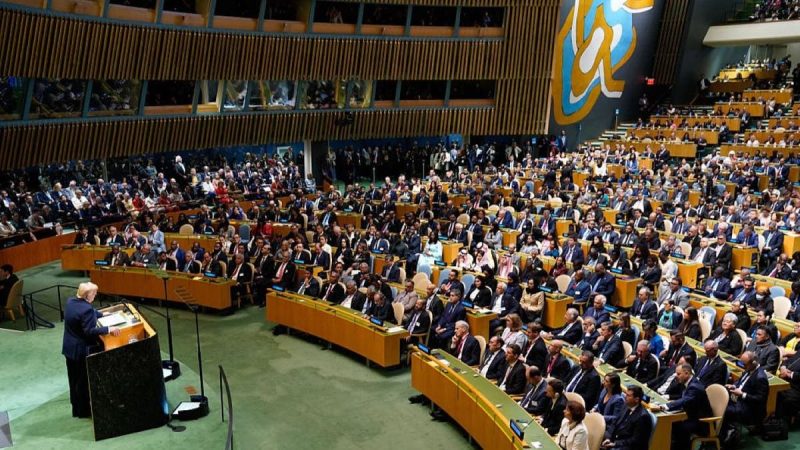
After the Trump administration’s decision to withdraw from dozens of United Nations and other international organizations, experts say more international bodies could soon find themselves on the chopping block.
The announcement that the U.S. wouldexit 66 international organizationswas in response to President Donald Trump’s February 2025 executive order calling for a review of U.S. support to ‘all international organizations.
Secretary of State Marco Rubio said in reaction to the announcement that the U.S. is ‘rejecting an outdated model of multilateralism — one that treats the American taxpayer as the world’s underwriter for a sprawling architecture of global governance.’ Rubio warned the State Department continues to review international organizations, and that those subject to the January cuts ‘are by no means the only offenders.’
Rubio said that the U.S. was not turning its back on the world but was looking to review the ‘international system,’ which he said, ‘is now overrun with hundreds of opaque international organizations, many with overlapping mandates, duplicative actions, ineffective outputs and poor financial and ethical governance.’
Hugh Dugan, former Senior Director for International Organization Affairs at the National Security Council during President Trump’s first term, told Fox News Digital that U.N. Secretary General Antonio Guterres ‘always misread’ the prior executive order ‘as a cost-cutting directive.’ In trying to ‘cut his way to growth’ through the UN80 initiative,
Dugan said that Guterres ‘meat-cleavered budgets, hitting bone and flesh as much as fat, but at base it was business as usual: no focus on the U.N.’s pitiful return on investment. Instead of only cutting the bottom line, also he should have grown the top line by working smarter for new efficiencies.’
Launched in March 2025, the UN80 initiative was designed to identify inefficiencies inside the U.N. system and cut costs across an expansive bureaucracy. In response to Trump’s withdrawal from U.N. entities, Guterres’ spokesperson Stéphane Dujarric said in a statement that the secretary general, ‘regrets the announcement by the White House,’ and stated that ‘assessed contributions to the United Nations’ regular budget and peacekeeping budget…are a legal obligation under the U.N. Charter for all Member States, including the United States.’
Brett Schaefer, a senior fellow at the American Enterprise Institute, told Fox News Digital that impacted organizations external to the U.N. ‘don’t receive very much money,’ and ‘don’t necessarily merit U.S. funding or support.’ Withdrawing from those organizations is ‘more pruning around the margins than a fundamental reassessment of U.S. relationships with international organizations,’ he said.
For the 31 U.N.-affiliated groups on the list, Schaefer said that the withdrawal order is ‘an opportunity to signal to the U.N. where the United States would like to see consolidation or elimination of duplication, which is rather rife within the U.N. system.’
Schaefer said that withdrawing from the U.N. Population Fund and U.N. Framework Convention on Climate Change was ‘very consistent with the Trump administration’s policy.’ Schaefer also indicated that withdrawing from the U.N. Council on Trade and Development (UNCTAD) was a formalization of policy shift that occurred in 2018 when UNCTAD admitted ‘Palestinians as a full member state’ and U.S. law ‘prohibit[ed] U.S. funding’ for the organization.
Other choices, like departing from the U.N. Department for Economic and Social Affairs, ‘didn’t quite make sense,’ Schaefer said. He noted that the department is funded through the regular U.N. budget, which makes the move ‘more of a signal than it is really an effective policy.’
Future rounds of cutting
Schaefer noted several organizations, including the World Meteorological Organization, World Intellectual Property Organization, U.N. Office for the Coordination of Humanitarian Affairs (UNOCHA), Food and Agricultural Organization (FAO), and U.N. Development Programme, that could be subject to future cuts.
While smaller nations utilize the UNDP to administer their humanitarian donations, the U.S. does not need ‘a middleman’ to fund non-governmental organizations and provide aid, Schaefer said. He also noted that the organization ‘has had a problem with corruption’ that included concealing North Korean counterfeit money and providing the country with dual-use technology.
Schaefer said that the U.S. can ‘promote agricultural development in developing countries’ through entities outside the FAO, which he said is ‘currently led by a Chinese national’ who is ‘using that organization to promote Chinese policies and Chinese commercial interests in developing countries.’
On Dec. 31, UNOCHA was a signatory to a memo ‘which was sharply critical of Israel,’ Schaefer said. Schaefer believes the memo constituted ‘a violation of their neutrality’ that should result in reprimand. Schaefer said that Under-Secretary-General for Humanitarian Affairs and Emergency Relief Coordinator Tom Fletcher ‘has made repeated statements echoing false accusations of Israel causing famine and hunger and other humanitarian suffering in Gaza that has since been proved to be false and without basis.’
The WIPO, WMO, and FAO declined to comment about whether they might be a target of future cuts.
A UNDP spokesperson said that the U.S. ‘has been a steadfast partner’ and that the it maintains its commitment to working alongside the U.S. to ‘address urgent humanitarian needs, promote stability, and advance prosperity worldwide.’ The spokesperson noted that ‘UNDP projects are subject to strict oversight and accountability policies and mechanisms,’ with the UNDP ‘consistently rank[ing] amongst the most transparent organizations included in the [Aid Transparency Index.]
According to the UNDP spokesperson, ‘no evidence of systematic fraud or diversion of funds was found’ when concerns involving the Democratic People’s Republic of Korea were investigated in 2006. The spokesperson said that the DPRK project ‘concluded in 2020. Any future engagement would require consensus from UNDP’s Executive Board and clear directives from Member States.’
A UNOCHA spokesperson noted that the U.S. had just signed an agreement with UNOCHA ‘reinforcing our partnership.’
The U.S. pledged to allocate $2 billion to UNOCHA at the end of December for global humanitarian needs.[iii] In recent years, officials previously told Fox News Digital that the U.S. had contributed between $8 and $10 billion to UNOCHA